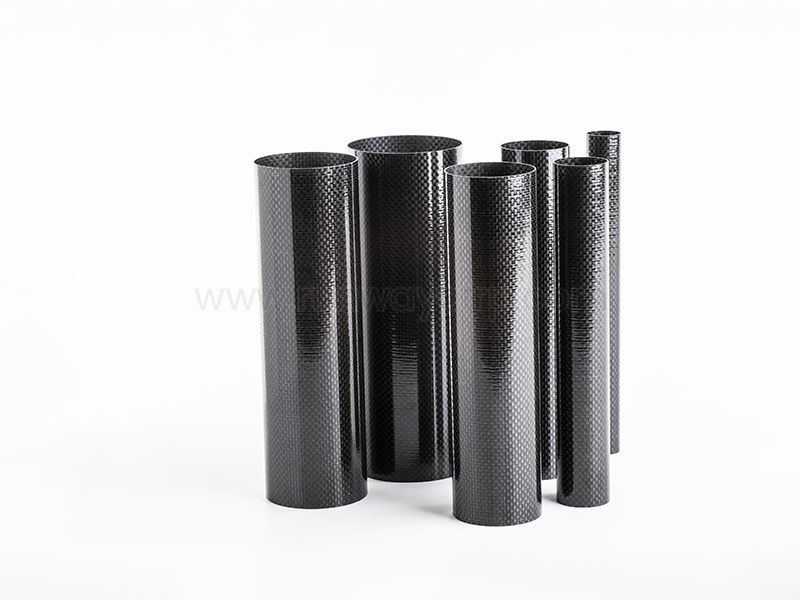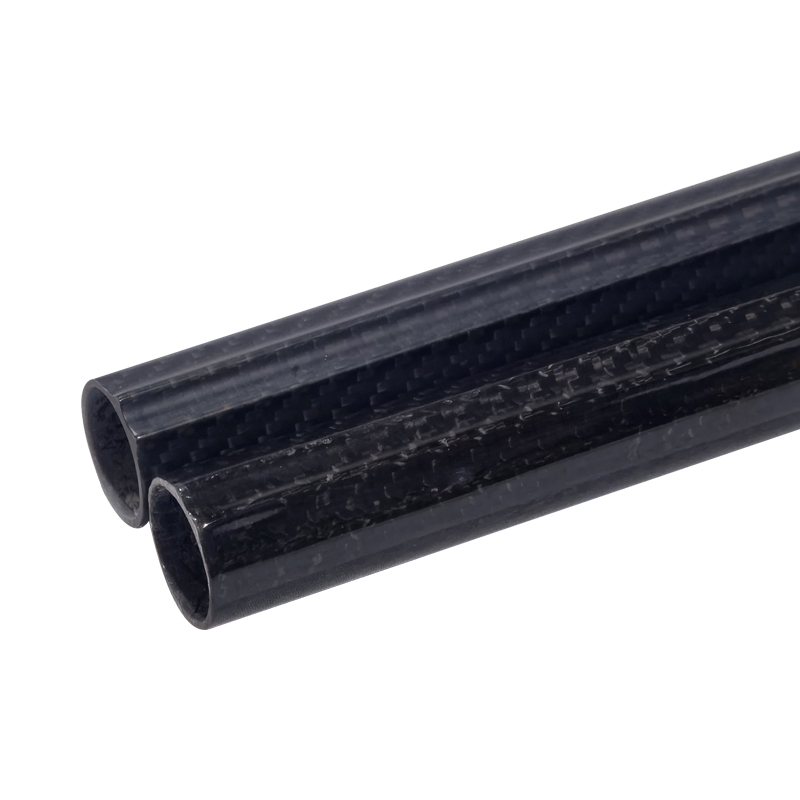
Carbon fiber round tubes provide five principal engineering advantages: a high strength-to-weight ratio, stiffness, corrosion resistance, dimensional stability, and design flexibility. These properties support lightweight structural frames, aerospace components, automotive systems, robotics, marine equipment, and precision assemblies where mass, deflection, and service life must be controlled.
When I evaluate structural tubing, I do not compare materials by tensile strength alone. I also examine weight per meter, bending stiffness, torsional behavior, fatigue exposure, environmental resistance, connection design, machining requirements, tolerances, and total cost of ownership. This approach explains why carbon fiber round tubes can outperform aluminum in some systems while remaining unsuitable for others.
Carbon fiber round tubes reduce structural mass while maintaining tensile and flexural performance for demanding engineering assemblies.
Their circular geometry distributes bending and torsional stresses more evenly than many non-round profiles.
Carbon fiber maintains corrosion resistance and dimensional stability where moisture, chemicals, or outdoor exposure affect metal tubing.
Fiber orientation, wall thickness, diameter, temperature, and connection design determine real-world tube load capacity.
Higher purchase cost, impact sensitivity, machining difficulty, and metal-contact corrosion require lifecycle planning before selection.
A carbon fiber round tube is a hollow cylindrical composite component made from continuous carbon fibers embedded in a polymer resin, commonly epoxy. Unlike isotropic metals, carbon fiber composites are directionally engineered, meaning their strength and stiffness depend on fiber orientation, laminate construction, diameter, and wall thickness. A tube may use axial fibers for tension and compression, ±45-degree layers for torsion, and hoop fibers for radial stability.
Manufacturers generally produce round tubes through pultrusion, roll wrapping, filament winding, or combinations of these processes. Pultruded Carbon Fiber Tubes are suited to straight, constant cross-sections and often emphasize axial stiffness, while roll-wrapped tubes allow more control over fiber angles and laminate sequences. Filament-wound tubes are useful when continuous fibers must follow helical paths around the circumference, especially for torsional or pressure-related loading.
Runway, manufactures carbon fiber tubes and related composite shapes using filament winding, roll wrapping, and pultrusion. Its published product information lists standard tube examples ranging from 4 mm to 20 mm outside diameter, wall thicknesses from 0.5 mm to 2.0 mm, and standard lengths of 1,000 mm, 1,500 mm, and 2,000 mm. The same product information identifies T300-3K and T700-3K carbon fiber options with epoxy resin systems.
The first advantage is mass reduction. Carbon fiber composite density commonly falls near 1.5–1.6 g/cm³, compared with approximately 2.7 g/cm³ for aluminum and approximately 7.8 g/cm³ for carbon steel. This density difference allows engineers to reduce the mass of frames, arms, booms, braces, shafts, and support members without automatically reducing load capacity.
Runway lists a theoretical weight of approximately 25 g/m for one Ø10 mm × 1.0 mm wall carbon fiber tube example. The actual mass of an aluminum tube with the same nominal dimensions depends on alloy, tolerances, and surface condition, but the composite option can provide a meaningful reduction where the design is governed by mass rather than only by material price.
A lower tube mass creates secondary engineering benefits. In a robotic arm, reducing the mass of the moving member lowers actuator torque and bearing loads. In a drone frame, lower arm mass can increase payload margin or flight endurance. In aerospace structures, lower component mass can reduce the required capacity of adjacent brackets, fasteners, and support systems.
The carbon fiber tube strength-to-weight ratio becomes particularly valuable when structures are suspended, accelerated, or repeatedly repositioned. However, I would not use a generic material value as the final design input. The design team should request laminate-specific tensile, compressive, flexural, and interlaminar data for the actual tube construction.
Carbon fiber round tubes can provide substantial stiffness at a low mass because carbon fibers have a tensile modulus that is much higher than the polymer matrix. Runway lists a typical tensile modulus of at least 120 GPa for one carbon fiber tube product range, along with tensile strength of at least 2,000 MPa and flexural strength of at least 1,500 MPa. These figures should be treated as product-specific targets rather than universal values for every carbon tube.
For a hollow circular tube, bending stiffness depends strongly on the second moment of area. Increasing the outside diameter can improve bending stiffness more efficiently than simply adding material near the neutral axis, although the relationship also depends on wall thickness and local stability. This is one reason carbon fiber round tubes are used for long, slender members such as UAV arms, camera supports, inspection poles, and robotic links.
Round tubes also resist torsional deformation through their closed cross-section. Under pure torsion, the continuous perimeter helps carry shear flow around the tube, while ±45-degree fiber layers can be added to transfer torque more effectively. A pultruded tube with mostly axial fibers may deliver strong axial performance but require a different laminate design when twisting loads are significant.
Deflection must be checked separately from ultimate strength. A tube can remain below its tensile limit while still bending too far for a camera mount, optical instrument, linear guide, or robot end effector. For precision systems, I would specify allowable deflection, torsional angle, and vibration frequency in the drawing rather than relying only on a material tensile rating.
Carbon fiber round tubes are suitable for structures exposed to repeated loading when the laminate is correctly designed and protected from local damage. Carbon fibers have low strain under a given stress compared with many metals, which can reduce cyclic deformation in properly sized members. The resin, fiber-matrix interface, joints, surface condition, and stress concentrations still control fatigue life.
Fatigue evaluation should match the application. A robotic arm may experience millions of relatively moderate cycles, while an automotive brace can see vibration, impact, thermal cycling, and road-induced loads. For qualification, engineering teams may use procedures such as ASTM D3479 for tension-tension fatigue of polymer matrix composites, while tensile and flexural properties may be measured using ASTM D3039 and ASTM D790 methods where applicable.
The round profile helps reduce certain geometric stress concentrations. A circular tube does not have sharp external corners, and its wall can distribute bending loads around the circumference. This geometry can be beneficial in rotating members, booms, arms, and frames where loads change direction during operation.
Durability does not mean immunity to damage. A tube that survives years of normal tensile loading may fail after a concentrated impact, crushed edge, poorly drilled hole, or over-tightened clamp. For field equipment, I recommend specifying impact inspection criteria, minimum bend radius for attached cables or straps, and torque limits for all clamps and fasteners.
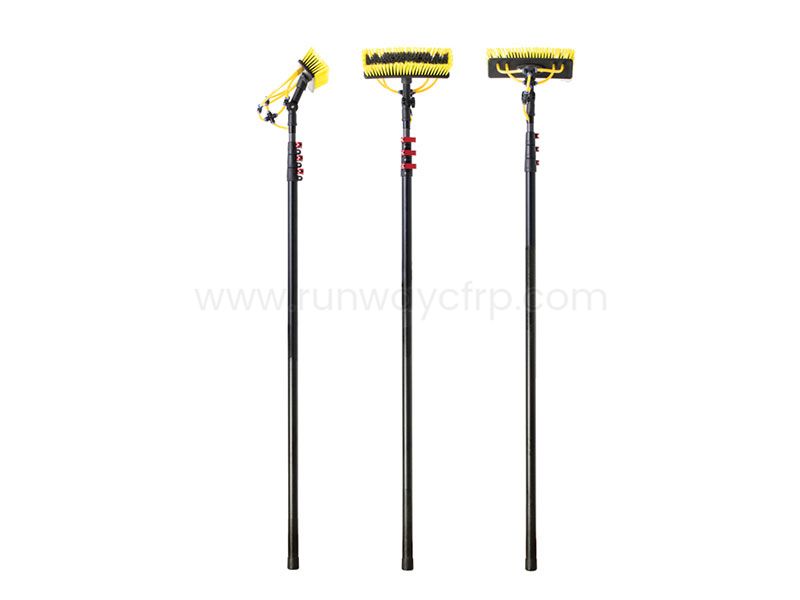
Carbon fiber round tubes do not rust in the same way as steel and generally resist water, salts, and many industrial chemicals better than unprotected metal tubing. This makes them useful in marine equipment, water-fed poles, outdoor inspection systems, chemical-handling fixtures, and transportation structures. The surrounding resin, coating, adhesive, and metal hardware still need environmental evaluation.
The composite’s low moisture sensitivity and low thermal expansion along the fiber direction can help maintain dimensional stability. This matters in optical benches, measurement frames, robotic fixtures, and aerospace assemblies where alignment changes can affect performance. Carbon fiber is not uniformly stable in every direction, because transverse expansion is influenced by resin content, fiber architecture, temperature, and moisture exposure.
Temperature limits must be defined before purchase. Standard epoxy systems may lose stiffness as they approach their glass-transition temperature, and a tube designed for room-temperature service may not retain the same mechanical properties in an engine bay, exhaust-adjacent structure, or elevated-temperature industrial process. I would request the resin system, glass-transition temperature, recommended service range, and post-cure requirements.
A major environmental issue occurs when carbon fiber contacts aluminum, magnesium, or other susceptible metals in the presence of an electrolyte. Carbon fiber can form a galvanic couple with less noble metals, increasing corrosion at the metal interface. Isolation washers, glass-fiber barriers, suitable coatings, sealants, and controlled drainage should be included in the connection design.
Carbon fiber round tubes allow engineers to tailor performance through diameter, wall thickness, fiber type, resin system, surface finish, and fiber layup. Runway lists T300-3K and T700-3K options, along with custom outside and inside diameters, wall thicknesses, lengths, and surface finishes. This range supports both standard replacement parts and application-specific structural designs.
Fiber orientation is one of the most important design variables. A 0-degree layer primarily supports axial tension and compression, ±45-degree layers improve shear and torsional load transfer, and 90-degree or hoop layers help stabilize the wall against splitting and local deformation. A tube designed only for axial stiffness may not perform well when subjected to torque, transverse impact, or clamped connections.
The round geometry also supports nested assemblies and telescoping systems. Different tube diameters can slide inside one another when tolerances, surface finishes, and clearance are controlled. This is useful for camera poles, rescue poles, inspection equipment, antenna supports, adjustable frames, and deployable structures.
Customization must include manufacturability limits. Very thin walls may be vulnerable to ovalization, local buckling, or handling damage, while very thick laminates can increase cost without improving the governing failure mode. A supplier should review the load case, drawing tolerances, cut-length requirements, hole locations, end finishing, and packaging method before quoting.
A circular tube distributes external bending stress around a continuous perimeter. Under symmetrical loading, this can reduce the directional weakness that may occur at the corners of square or rectangular profiles. The actual stress distribution still depends on support conditions, wall thickness, cutouts, clamps, and laminate orientation.
Round tubes are especially useful when loads can arrive from multiple directions. A robotic linkage, UAV arm, sports frame, or marine support may experience bending in more than one plane. A circular section provides consistent geometric behavior as the load direction changes, although the composite laminate may remain anisotropic.
Closed circular sections are efficient in torsion because shear stress can circulate around the tube wall. To take advantage of this geometry, the laminate should contain suitable ±45-degree fibers rather than relying only on longitudinal reinforcement. If torque is a primary load, I would ask for torsional stiffness, torsional failure torque, and test conditions instead of accepting axial tensile data as a substitute.
Bending capacity depends on the tube’s diameter, wall thickness, unsupported length, end conditions, and laminate structure. Thin-walled tubes can fail through local buckling or wall ovalization before the carbon fibers reach their nominal tensile strength. A larger diameter can increase bending stiffness, but it may require internal supports, local sleeves, or thicker end regions near bolted connections.
The question of carbon fiber tubes vs aluminum tubes is not answered by strength alone. Aluminum is isotropic, easier to cut and drill, more tolerant of localized bearing loads, and usually less expensive for standard shapes. Carbon fiber offers lower density, tailored stiffness, corrosion resistance, and lower thermal expansion in selected directions, but it requires more careful design and inspection.
| Factor | Carbon Fiber Round Tube | Aluminum Tube |
|---|---|---|
| Typical density | Approximately 1.5–1.6 g/cm³ | Approximately 2.7 g/cm³ |
| Strength direction | Directional and laminate-dependent | More uniform in all directions |
| Stiffness design | Tailored through fiber orientation and diameter | Determined mainly by alloy and geometry |
| Corrosion behavior | Does not rust; galvanic risk with some metals | Oxidizes and may pit in aggressive environments |
| Fatigue behavior | Depends strongly on laminate and joints | Well characterized for many alloys |
| Machining | Requires abrasive tooling and dust control | Standard metalworking equipment |
| Joining | Adhesive bonding, bonded inserts, clamps, or hybrid joints | Welding, bolting, riveting, and machining |
| Purchase cost | Often higher, especially for custom parts | Generally lower for standard profiles |
| Recycling | More difficult because fiber and resin are bonded | Established metal recycling routes |
| Best fit | Weight-sensitive, stiff, corrosion-exposed systems | Cost-sensitive, impact-prone, easily serviced structures |
I would choose aluminum when the project prioritizes low initial cost, rapid modification, frequent drilling, or high impact tolerance. I would choose carbon fiber when mass, vibration control, corrosion resistance, or directional stiffness produces measurable system-level value. The decision should include manufacturing labor, replacement frequency, energy use, downtime, and the cost of adjacent components.
Aerospace and UAV systems benefit from low mass and high bending stiffness. Carbon fiber round tubes are commonly used in drone arms, lightweight booms, instrument supports, antenna structures, and experimental airframes. In these applications, designers must check buckling, vibration, hard-point loads, and the effect of drilled or clamped connections.
Automotive applications include braces, drive-system supports, exhaust-related components, interior structures, and specialized lightweight frames. The main advantage is often a reduction in unsprung or moving mass, but temperature, impact, fuel or chemical exposure, and joining requirements can limit the material choice. For exhaust-adjacent parts, the resin system and thermal barrier must be specified rather than assumed.
Robotic structural members require stiffness because deflection at the end effector can multiply positioning error. A lighter carbon tube can also reduce motor torque and improve acceleration, but the joints need careful design. Bonded inserts, metallic end fittings, composite sleeves, or clamped interfaces can prevent crushing the tube wall.
Carbon fiber tubes resist saltwater-related corrosion better than many metals, making them suitable for masts, poles, booms, fishing equipment, marine frames, and inspection tools. Protective coatings and sealed ends remain important because water can enter through drilled holes, joints, or open laminate edges. In mixed-material assemblies, electrical isolation should be included.
Sports equipment, camera supports, medical devices, linear systems, and industrial fixtures use carbon fiber tubes when low mass and controlled stiffness affect handling or positioning. Runway lists applications including medical and rehabilitation equipment, industrial automation, sporting goods, UAV arms, and instrument rods. Each application requires different surface, tolerance, impact, and connection specifications.
Start by recording axial force, bending moment, torque, compression length, vibration frequency, impact exposure, and expected cycle count. Do not describe the requirement only as “strong” or “lightweight.” A supplier needs numerical loads, safety factors, support conditions, and allowable deflection.
For example, a tube carrying 1,000 N in axial compression has a different design problem from a tube carrying 100 N·m of torque. The first may be governed by fiber-direction compression or global buckling, while the second may require a ±45-degree-dominant laminate. The same outside diameter can produce very different results under these two load cases.
Diameter affects bending stiffness and handling clearance, while wall thickness affects local stability, bearing strength, and damage tolerance. A thin 0.5 mm wall may suit a low-load instrument rod, but a 1.5 mm or 2.0 mm wall may be more appropriate near clamps, inserts, or impact zones. Runway publishes wall-thickness examples from 0.5 mm to 2.0 mm, but the correct value must come from the engineering load case.
Compare the required stiffness with the available envelope. If space permits, increasing diameter can be more efficient than adding layers near the neutral axis. If the tube must fit inside a compact mechanism, increased wall thickness may be necessary to preserve stiffness and connection strength.
Use pultrusion for straight, constant-section parts where axial stiffness and repeatable production are primary objectives. Consider roll wrapping when the design needs specific axial, hoop, or ±45-degree layers and controlled wall construction. Filament winding can support longer lengths and helical fiber paths for applications involving torsion or pressure.
Ask for the nominal fiber volume, resin system, cure method, ply angles, and inspection plan. A product described only by “carbon fiber” does not provide enough information for structural qualification. The same T300 or T700 fiber can produce different performance when the orientation, resin content, and wall architecture change.
Specify operating temperature, short-term temperature peaks, humidity, ultraviolet exposure, chemicals, saltwater, and cleaning agents. Confirm the resin’s glass-transition temperature and any recommended coating or post-cure. Also state whether the tube may be dropped, struck, clamped repeatedly, or exposed to loose debris.
For outdoor structures, I would request sealed ends and a surface finish that supports inspection. For impact-prone equipment, hybrid carbon-glass construction or local protective sleeves may provide a more appropriate balance than a thin, carbon-only laminate.
Joining is frequently the controlling issue. Options include adhesive bonding, bonded metallic inserts, compression clamps, mechanical fasteners with local reinforcement, and hybrid fittings. Drilling holes through a laminate can cut load-bearing fibers and create delamination, so hole diameter, edge distance, torque, and washer size must be specified.
For bonded joints, define surface preparation, adhesive type, bond-line thickness, cure temperature, and overlap length. For metallic fittings, isolate carbon fiber from aluminum or magnesium to reduce galvanic corrosion. A tube supplier with CNC machining support can also help produce drilled, cut, chamfered, or fitted components, but the drawing should identify every tolerance and inspection feature.
A professional purchase specification should include more than the tube diameter and length. I recommend listing outside diameter tolerance, inside diameter tolerance, wall-thickness tolerance, straightness, cut-length tolerance, surface defects, fiber orientation, resin system, minimum mechanical properties, and packaging requirements. If the tube will enter a regulated aerospace, medical, or automotive program, the supplier should identify applicable material certifications and traceability documents.
Runway describes incoming material inspection, in-process dimensional and strength checks, final inspection before shipment, and export-ready packaging as part of its production approach. Its published capabilities include standard and customized tubes, multiple reinforcement types, and production methods covering filament winding, roll wrapping, and pultrusion. Buyers should still request sample inspection reports, batch identification, test methods, and acceptance criteria for the specific order.
Delivery risk should be managed through a documented procurement schedule. Confirm whether the quotation covers tooling, samples, first-article inspection, CNC operations, surface finishing, packaging, and replacement of nonconforming parts. For a production program, I would also request a pilot batch before committing to annual volume and identify a second-source option for critical assemblies.
Carbon fiber round tubes often have a higher purchase price than aluminum tubes, but purchase price is only one part of the economic calculation. The total cost may include machining, joining hardware, protective coatings, inspection, shipping volume, replacement parts, downtime, and the energy required to move the finished assembly. A lighter component can create savings in motors, actuators, bearings, fuel, battery capacity, and support structures.
For example, if replacing a metal frame reduces moving mass by 20%, the system may require less actuator torque or may achieve the same acceleration with a smaller drive. That benefit should be calculated from actual motor efficiency, operating hours, electricity price, and expected service life rather than presented as a general claim. In an aerospace or UAV system, the value may instead appear as additional payload capacity or longer operating time.
A simple comparison model can include:
| Cost Category | Carbon Fiber Round Tube | Aluminum Tube |
|---|---|---|
| Material purchase | Supplier quotation | Supplier quotation |
| Machining and finishing | Composite cutting, drilling, dust control | Conventional machining |
| Joining hardware | Inserts, adhesives, isolators, clamps | Fasteners, welds, or rivets |
| Assembly labor | Often higher during first production | Often lower for standard designs |
| Replacement frequency | Depends on impact and inspection results | Depends on fatigue and corrosion |
| Operating energy | Potentially lower for moving systems | Usually higher when mass is greater |
| End-of-life processing | Composite-specific disposal or recovery | Established metal recycling |
| Downtime exposure | Linked to supply and custom tooling | Often easier to source locally |
I would calculate payback using the actual annual operating benefit divided by the carbon fiber system’s incremental cost. If the added carbon fiber cost is $2,000 and the measured annual energy, maintenance, and replacement saving is $800, the simple payback is 2.5 years. If no system-level saving can be quantified, aluminum may remain the more rational selection despite carbon fiber’s technical benefits.
Round tubes are not automatically better than square or rectangular profiles. A square tube may provide flat mounting faces for brackets, sensors, panels, and fasteners. A rectangular tube can deliver greater bending stiffness in one preferred direction when the available height is larger than the width.
| Requirement | Preferred Profile |
|---|---|
| Loads arrive from several directions | Round tube |
| Torsion is a major design load | Round tube with ±45-degree reinforcement |
| Flat surfaces are needed for mounting | Square or rectangular tube |
| Bending is concentrated in one plane | Rectangular tube |
| Telescoping or nested sections are required | Round tube |
| Simple bolted joints are required | Square or rectangular tube may simplify hardware |
| Low aerodynamic drag is important | Depends on external fairing and orientation |
| Local impact and bearing loads dominate | Profile and local reinforcement must be tested |
The correct selection depends on load direction, connection geometry, available space, access for inspection, and production volume. I would compare the complete assembly rather than the bare tube because a round tube may require additional brackets while a rectangular profile may require more material to achieve the same torsional performance.
The five advantages should be balanced against several limitations. Carbon fiber tubes can cost more than aluminum, particularly when the tube requires custom tooling, small-batch production, tight tolerances, inserts, or CNC machining. The material is also more sensitive to localized impact and crushing than ductile metals.
Machining requires abrasive-resistant tools and controlled dust extraction. Drilling without suitable support can produce splintering or delamination, and poorly designed fastener holes can reduce load capacity. Bonding can provide an efficient joint, but it requires controlled surface preparation, adhesive storage, cure conditions, and inspection.
Recycling is more difficult because carbon fibers are embedded in a cured resin matrix. Mechanical, thermal, and chemical recovery methods exist, but recovered fibers may not retain the same length or performance as virgin reinforcement. For projects with strict sustainability targets, the end-of-life pathway should be considered during material selection.
Top 5 Advantages of Carbon Fiber Round Tubes in Modern Engineering are lightweight construction, high strength-to-weight ratio, stiffness and fatigue capability, corrosion resistance, dimensional stability, and design flexibility. I consider carbon fiber round tubes a strong candidate when the assembly is weight-sensitive, exposed to moisture or chemicals, subject to repeated bending, or required to maintain alignment under changing loads.
The best results come from matching the tube to the load case rather than selecting a material by reputation. Define axial force, bending moment, torque, deflection, temperature, impact exposure, connection method, tolerances, and production volume before requesting a quotation. Then compare pultruded, roll-wrapped, and filament-wound construction against aluminum and against square or rectangular composite profiles.
For engineering buyers, the next step should be a controlled sample order with documented dimensions, laminate information, mechanical testing, and connection trials. Runway’s published carbon fiber tube range includes T300-3K and T700-3K options, epoxy resin systems, custom diameters, wall thicknesses from 0.5 mm to 2.0 mm, and lengths up to standard 2,000 mm examples, with larger custom tubes also described. Carbon Fiber Tube selection becomes financially sound when the measured savings in mass, energy, maintenance, or system capacity exceed the added material and integration costs.
+86 156 9543 6852
Science & Technology Industrial Park, Zhangdian, Zibo, Shangdong, China